
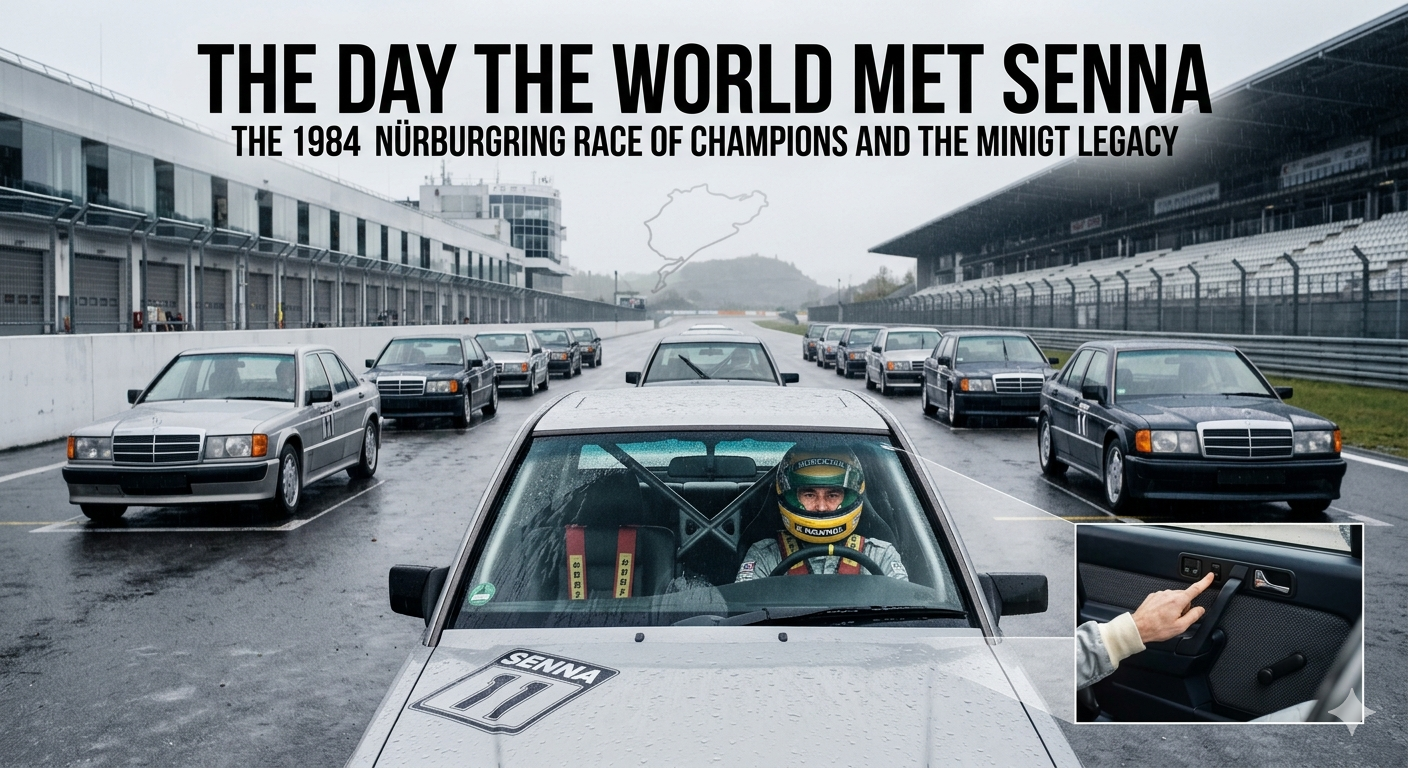
Introduction: The Rebirth of the “Green Hell”
On May 12, 1984, the global motorsport zeitgeist shifted its gaze back toward the Eifel mountains. For years, the legendary Nürburgring had existed in a state of suspended animation. Since Niki Lauda’s horrific, fire-engulfed accident at Bergwerk in 1976, Formula One had abandoned the 14-mile Nordschleife, deeming the “Green Hell” a relic of a more murderous era. The solution was the inauguration of the Grand Prix-Strecke (GP-Strecke), a 4.542 km facility designed to offer modern safety standards, wide run-off areas, and the commercial infrastructure necessary for a new decade of racing.
To celebrate this resurrection, Mercedes-Benz orchestrated the “Mercedes-Benz Cup,” an exhibition race with a dual mission. First, it was the official christening of the new circuit. Second, it served as the high-profile launch for the Mercedes-Benz 190 E 2.3-16, a car engineered to transform the brand’s image from a purveyor of stately cruisers to a dominant force in the compact sports sedan market.
What was intended as a lighthearted parade of the world’s greatest drivers in identical machinery quickly transformed into a masterclass of technical dominance. The afternoon would be defined by a 24-year-old Brazilian rookie—a man with only four Grand Prix starts who arrived as a last-minute substitute. This was the day Ayrton Senna da Silva stopped being a prospect and became a legend, initiating a legacy that lives on today, not only in racing history books but in the meticulous 1:64 scale recreations of MiniGT.
Collector’s Deep Dive: The MiniGT 1:64 Scale Model (#1076)
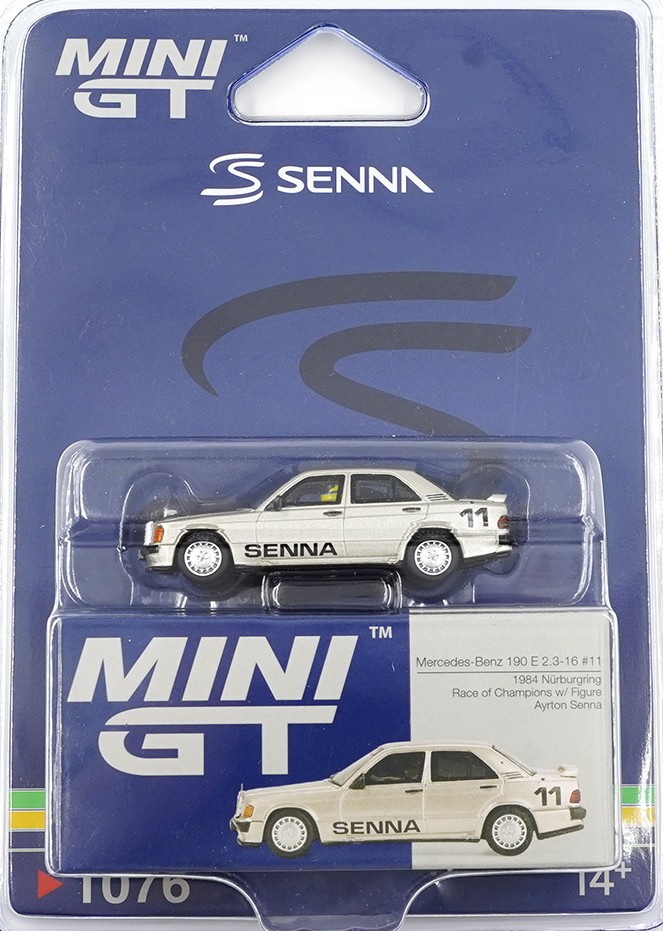
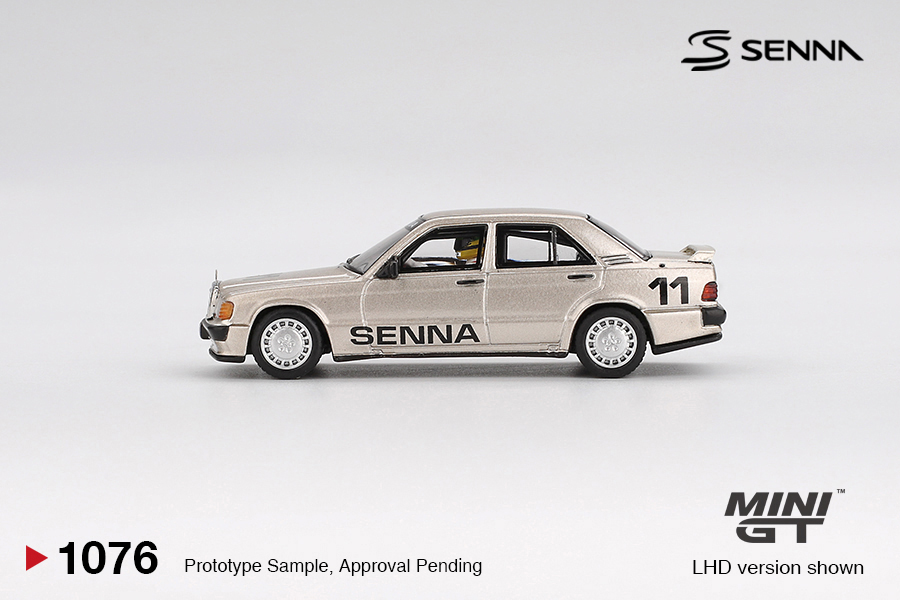
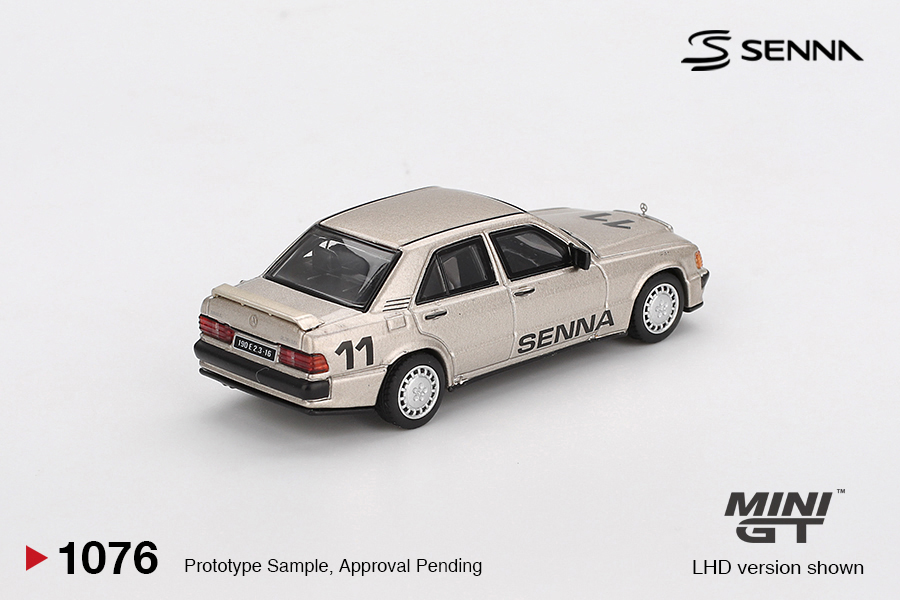
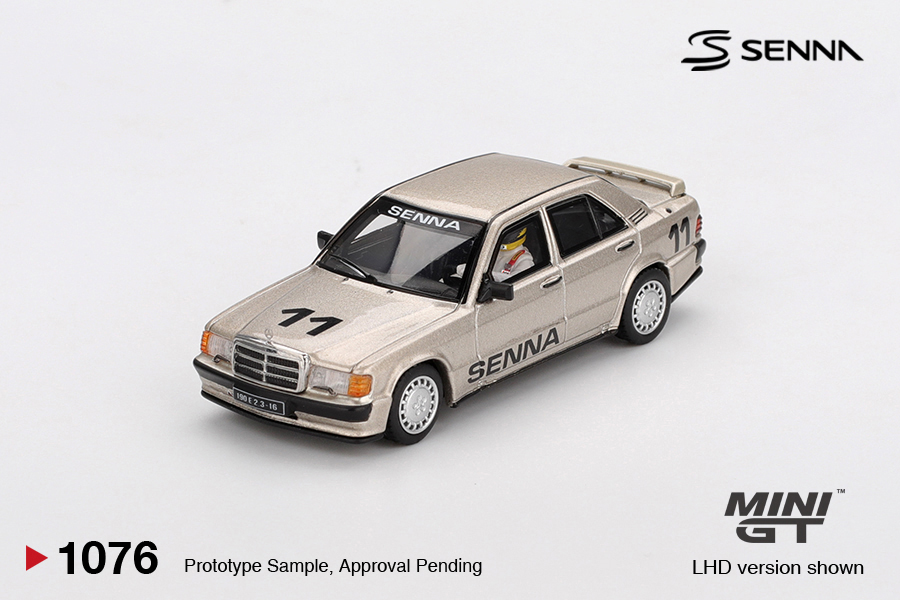
For the high-end collector, the MiniGT 1:64 scale Mercedes-Benz 190 E 2.3-16 (#1076) is more than a toy; it is a piece of historical preservation. MiniGT has captured the “Smoke Silver” (Champagne Gold) hue of the race-winning car with a fidelity that rivals much larger scales.
Feature List:
- Packaging & Licensing: The box carries the official Senna Institute license, adorned with the Brazilian flag colors and the iconic Ayrton Senna logo. It is a package clearly designed for the F1 historian.
- Exterior Accuracy: The model replicates the #11 livery perfectly, including the subtle rear wing and flared wheel arches. Look closer, and you will find the “delicacy” that MiniGT is known for: flexible side mirrors and a tiny, perfectly rendered Mercedes hood ornament—a detail almost unheard of in 1:64 scale.
- Tiny Technicals: The headlamp wipers are present, as are the quick-release bonnet pins. The “Rauchsilber” paint finish has the correct metallic flake, avoiding the “toy-like” sparkle found in cheaper diecast brands.
- The Driver Figure: This release includes a driver figure of Senna in his 1984 kit. The iconic yellow helmet and white overalls are rendered with precision, with the hands positioned realistically—one on the steering wheel, the other on the gear shifter of the dogleg Getrag box.
- Chassis & Base: The undercarriage is one of the best-detailed bases in the market, featuring technical licensing info and a replicated exhaust system. The wheels feature the classic Mercedes logo and roll freely, a hallmark of MiniGT’s rolling-axle engineering.
The Collector’s Verdict: Investment vs. Passion
In a modern hobby often plagued by “flip culture,” the MiniGT #1076 stands as a “mandatory” piece for the real collector. This model represents the intersection of two legends: the car that saved Mercedes’ sporting reputation and the man who redefined the driver’s role in F1.
The car’s enduring myth is currently celebrated in the “Ayrton Senna Forever” exhibition at the Museo Nazionale dell’Automobile in Turin. There, the actual #11 race car sits alongside Senna’s helmets and suits. Owning the MiniGT version is a way for collectors to capture that exhibition’s gravity. While the personal road car of Senna fetched £230,000 at auction, this 1:64 scale tribute allows enthusiasts to own the narrative of the Eifel mountains without the six-figure price tag.
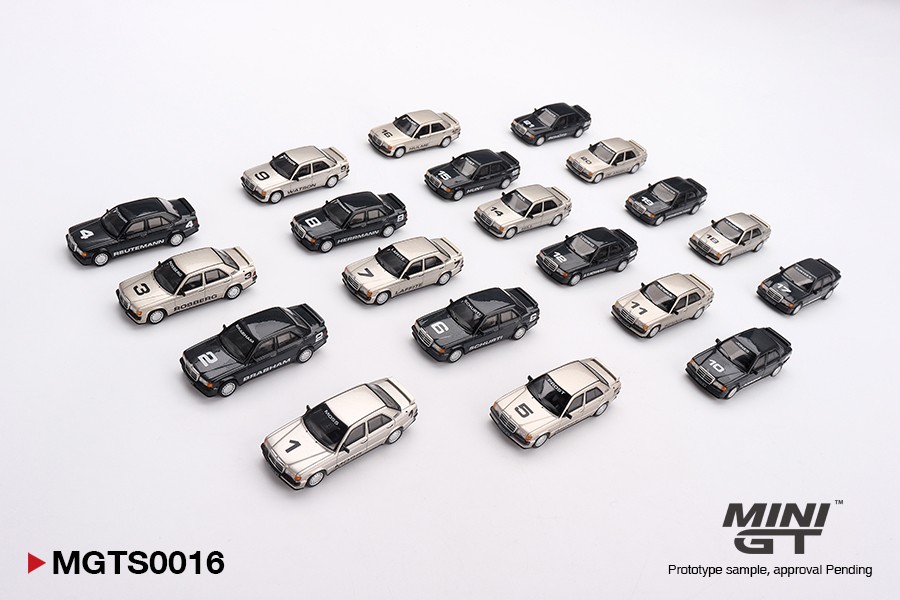
MiniGT has gone a step ahead and created complete set of all the cars of all the participating racers along with their names on respective cars. This is a Limited Edition Set limited to 5000 sets depicting 1984 Nürburgring Race of Champions.
The Machine: Mercedes-Benz 190 E 2.3-16 Technical Profile
The 190 E 2.3-16 was the technical crown jewel of the W201 platform. Developed to challenge the BMW 3 Series and serve as the homologation basis for Group A touring car racing, the project was born from a high-stakes collaboration with the British engineering maestros at Cosworth. While Mercedes-Benz provided the robust M102 iron block, Cosworth designed and cast a revolutionary lightweight alloy cylinder head.
This head featured dual overhead camshafts (DOHC) and four valves per cylinder. More importantly, it utilized a cross-flow construction—a high-performance layout that allowed for vastly improved breathing. In a move that signaled Mercedes’ future-proofing, the engine was designed to be environmentally friendly, capable of running on lead-free fuel thanks to the high-efficiency 16-valve combustion chambers.
Before the Race of Champions, the 190 E 2.3-16 had already proved its mechanical mettle. In August 1983, it famously set world endurance records at the Nardo test track, covering 50,000 km at an average speed of 247 km/h. It also set a Nürburgring record for a four-door production car with a lap time of 8 minutes and 46 seconds. For the 1984 exhibition, Gerhard Lepler of Mercedes-Benz Sport-Technik took 21 units directly from the production line and applied specific racing modifications.
Technical Specifications: Road vs. 1984 Race Modifications
| Feature | Standard Production (1984) | 1984 Race Modifications (Lepler) |
| Engine | 2.3L 16v M102 (Cosworth Head) | Standard internals; Silencers removed |
| Power Output | 185 hp @ 6,200 rpm | 185 hp (Enhanced racing acoustics) |
| Transmission | Getrag 5-speed “Dogleg” | Standard “Dogleg” pattern |
| Final Drive Ratio | 3.07:1 | 4.08:1 (Shortened for acceleration) |
| Suspension | Multi-link rear; Hydropneumatic | Lowered 15mm; Stiffer springs/shocks |
| Wheel Offset | ET 25 | ET 44 (Increased for a 2cm wider track) |
| Brakes | Standard dual-circuit discs | 4-piston front racing calipers |
| Tires | Pirelli P6 205/55 VR 15 | Pirelli P7 racing tires |
| Steering Wheel | 400 mm diameter | 380 mm diameter |
| Interior Items | Recaro bucket seats | Bolt-in roll cage; retained electric seats |
The most fascinating detail of these race machines was the retention of the luxury-spec electric seat adjustment. Even with the addition of a full roll cage and six-point racing harnesses, drivers like Niki Lauda and James Hunt still used the electronic toggle switches on the door panels to find their perfect driving position—a quintessentially Mercedes-Benz touch.
The Most Distinguished Grid in History
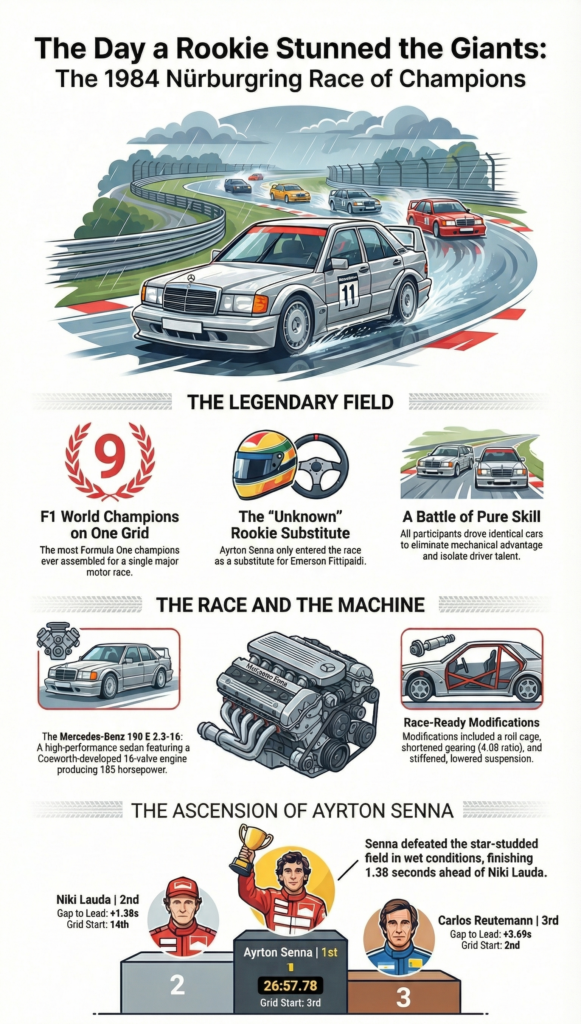
The field assembled for the Race of Champions remains the most decorated lineup ever to share a starting grid. Mercedes-Benz set out to invite every living Formula One World Champion and Nürburgring winner. Of the fourteen living champions at the time, nine were present.
The Nine World Champions
- Niki Lauda (1975, 1977): The emotional center of the event. Returning to the circuit that nearly took his life in 1976, Lauda was in the midst of a spectacular comeback season that would eventually lead to his third world title by a record-thin half-point margin later that year.
- Jack Brabham (1959, 1960, 1966): “Black Jack” was the elder statesman of the grid. Known for his technical brilliance and having won a title in a car of his own construction, the 58-year-old Australian brought a legendary gravity to the event.
- Phil Hill (1961): The first American F1 champion. Hill’s history with the Nürburgring was storied, and his presence reminded the crowd of the 1961 season at Monza, where he secured the title under the shadow of the Wolfgang von Trips tragedy.
- John Surtees (1964): The only man to win world titles on both two wheels and four. Surtees possessed an “obsessive” technical eye, which he would use to analyze the performance of a certain Brazilian rookie during the 12-lap race.
- Denny Hulme (1967): “The Bear” brought his signature grit. A veteran of the high-horsepower Can-Am and F1 eras, Hulme was a master of the mechanical nuance required to handle equal machinery in the wet.
- James Hunt (1976): The rockstar of the grid. Retired from F1 since 1979, Hunt arrived in the Eifel with his usual flair. While reports suggest the veterans enjoyed a heavy gala dinner the night before, Hunt’s lightheartedness on the grid masked a competitor who still hated to lose.
- Jody Scheckter (1979): The last man to win a title for Ferrari before the 21-year drought. Scheckter proved his enduring speed by setting the fastest lap of the race (2:12.50) on lap 11.
- Alan Jones (1980): The hard-charging Australian was known for his uncompromising style. Though his race was cut short by mechanical issues after three laps, his presence solidified the grid’s elite status.
- Keke Rosberg (1982): The reigning era’s master of car control. Rosberg’s flamboyant, sideways driving style was perfectly suited to the identical 190 E saloons, providing a spectacle of tire smoke and oversteer.
The “Rookie” Inclusion: Ayrton Senna
Ayrton Senna’s presence was a matter of pure serendipity. He was a stand-in for his countryman Emerson Fittipaldi, who was stateside preparing for the Indianapolis 500. At the time, Senna was a relative unknown to the German public, having only four GP starts for the underfunded Toleman team.
The dynamic of the weekend was established early. Alain Prost, who had already won two races in the 1984 season, actually gave Senna a lift from the airport to the track. Prost noted that the young Brazilian was “very pleasant” and chatty during the drive. However, as soon as practice commenced, the pleasantries ceased. Senna stopped speaking to Prost entirely, entering a state of total professional isolation. While veterans like Stirling Moss and Hans Herrmann were there to “provide thrills” and honor the brand, Senna arrived with the singular goal of proving he belonged at the pinnacle.
Narrative: 12 Laps in the Rain
The weather on May 12 was characteristically Eifel: cold, gray, and punctuated by light rain. The 120,000 spectators watched as 20 identical cars—ten in Rauchsilber (Smoke Silver) and ten in Blauschwarzmetallic (Blue-Black Metallic)—lined up on the grid. Alain Prost took pole position, with Carlos Reutemann second and Senna third.
The start was a chaotic collision of egos. Prost led into the first corner, but the hierarchy was shattered almost immediately when Elio de Angelis made contact with the rear of Prost’s car. The incident dropped the pole-sitter down to 15th and forced de Angelis into a two-lap pit stop for repairs.
Senna, driving the #11 Rauchsilber car, seized the lead by lap three with a maneuver on Prost that was described as “forceful,” effectively pushing the Frenchman off the track. This moment served as the unofficial opening chapter of the greatest rivalry in F1 history. As the race progressed, a technical duel emerged between Senna and Niki Lauda.
Lauda, who had qualified 14th after missing practice for TV commitments, carved through the field with surgical precision. The two traded the lead multiple times over the final eight laps. While James Hunt was seen gleefully straight-lining corners and bouncing over the grass for the crowd’s entertainment, Senna and Lauda were locked in a professional war. Senna’s lines in the wet were remarkably smooth; where others wallowed, his car appeared to “fly” over the kerbs of the new chicane.
By the final lap, Senna’s tactical discipline allowed him to pull a gap. He crossed the line 1.58 seconds ahead of the two-time world champion.
Final Race Results (Podium):
- 1st Place: Ayrton Senna (26:57.78)
- 2nd Place: Niki Lauda (+1.38)
- 3rd Place: Carlos Reutemann (+3.69)
- Fastest Lap: Jody Scheckter (2:12.50 on Lap 11)
The Calling Card: Historical Impact and Aftermath
Senna’s victory was the ultimate calling card. John Surtees was so moved by the rookie’s technical discipline—noting that Senna used the exact right amount of road while others were cutting chunks out of the infield—that he wrote to Enzo Ferrari, urging him to sign the Brazilian to “get the team in order.” Just three weeks later, Senna confirmed this potential with his legendary second-place finish in the torrential rain at the Monaco Grand Prix.
The race also left a physical legacy. Mercedes-Benz recognized the historical weight of the result immediately. Senna’s winning #11 car was taken directly from the track and placed into the Mercedes-Benz Museum in Stuttgart, where it remains today as a permanent exhibit with only 2,000 km on the odometer. Niki Lauda’s #18 car is the only other unit to survive in its original race specification; it was sold into private hands and eventually auctioned by RM Sotheby’s in 2023 for over $300,000. The other 18 units were reverted to road spec and sold to the public, making the survival of the Lauda/Senna cars a miraculous occurrence for historians.
Senna himself was so enamored with the performance of the 190 E that he purchased one for his personal use in October 1985. Taking delivery in Stuttgart with a 25% factory discount, he used the Smoke Silver 2.3-16 as his daily driver in the UK for two years, accumulating 25,000 miles. This car, often seen with the private plate “B15ENA,” was recently auctioned in 2025, serving as the ultimate testament to his personal connection with the model.
Conclusion: A Legacy in Small Scale
The 1984 Nürburgring Race of Champions was the day the old guard felt the first tremors of the coming Senna era. It proved that pure talent, when filtered through equal machinery, is undeniable. Forty years after that rainy afternoon in the Eifel, the connection between the 190 E 2.3-16 and Ayrton Senna remains one of the most resonant stories in motorsport.
Through the preservation of the original car in Stuttgart and the meticulous craftsmanship of MiniGT, that single afternoon is now permanent. On the shelves of collectors worldwide, the Smoke Silver #11 remains a symbol of the moment a rookie became a king—proving that sometimes, the greatest legends come in the smallest scales.