
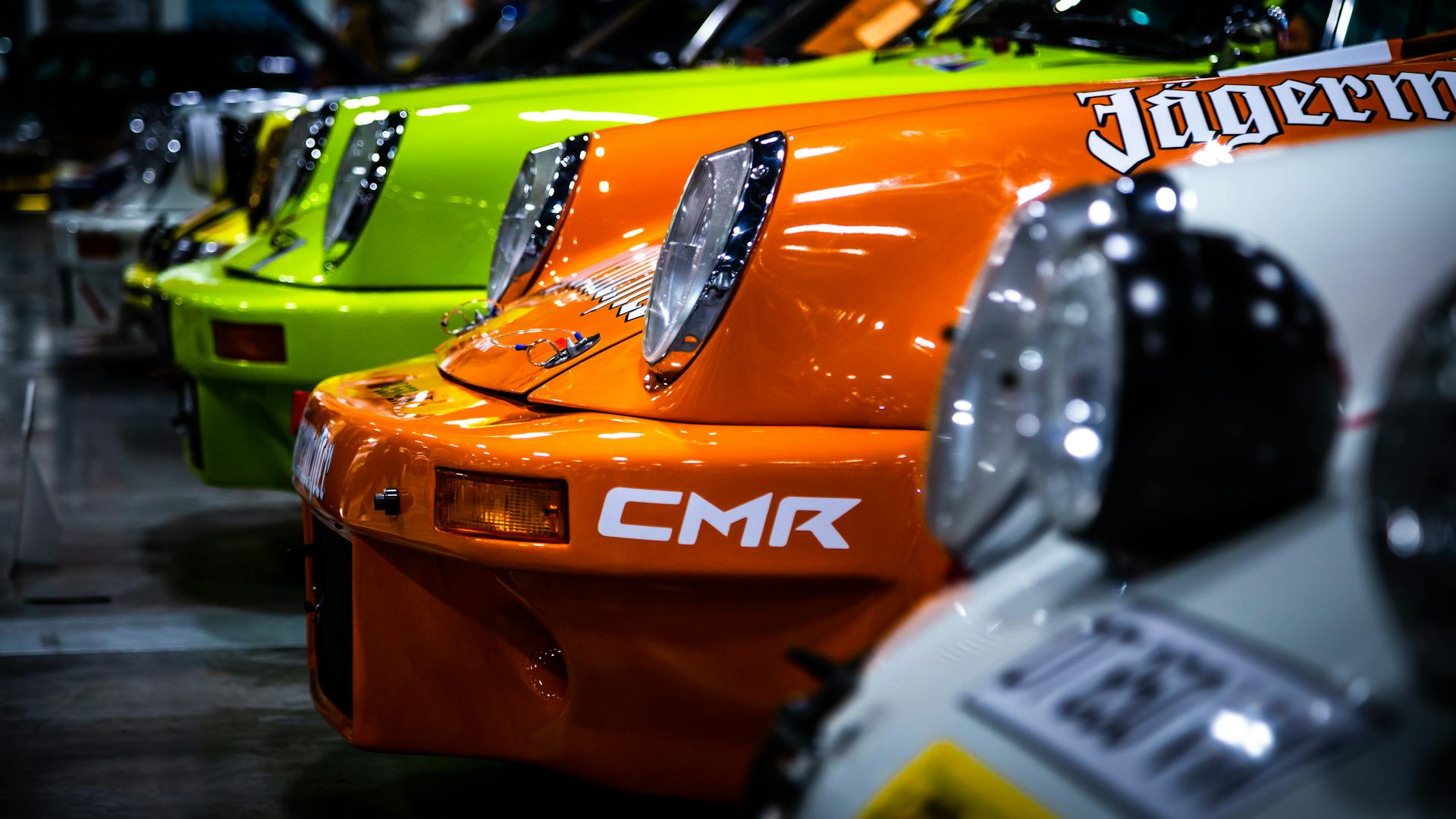
The Polarization of the 911
The air inside a Jacob K. Javits Convention Center hall usually carries the sterile scent of new upholstery and floor wax. But in April 2025, at the New York International Auto Show, the atmosphere is distinctly different. It smells of resin, metal shavings, and the unmistakable, lingering haze of Winston cigarettes. At the center of a frenzied crowd stands a man in war-torn Nike Air Force 1s, an air-powered saw in his hand, poised to perform a ritual that remains the most controversial act in modern automotive culture.
This is Akira Nakai, the man the Japanese media calls the “Porsche Charisma Tuner.” To some, he is a Zen-like master craftsman, an artist whose medium is the Teutonic silhouette of the Porsche 911. To others, specifically the traditionalist bisection of the Porsche community, he is the ultimate vandal, a “hack” who defaces six-figure German engineering with hardware store sealant and a reckless disregard for factory lines.
The tension between these two worlds has never been more palpable. As Nakai-san performs his first-ever live auto show build on a 2006 Porsche Carrera S (997), the Rauh-Welt Begriff (RWB) phenomenon stands as a global masterclass in brand building and cultural subversion. How did a former drift racer from Chiba, Japan, with a single Rimowa suitcase of tools and a supermarket bag for his clothes, redefine a German icon? To understand RWB, one must look past the gargantuan wings and into the grit of the workshop, the philosophy of the irreversible cut, and the “Rough World” concept that has captured the imagination of a new generation.
The “Rough” Origin Story (From Drifting to Stella Artois)
The genesis of RWB is not found in a clean-room design studio in Stuttgart, but on the midnight mountain passes and industrial docks of Chiba Prefecture. Before the Porsches, there was “Rough World,” a legendary street-drifting crew that pushed the limits of the Toyota Corolla AE86 during the late 1980s and early 90s.
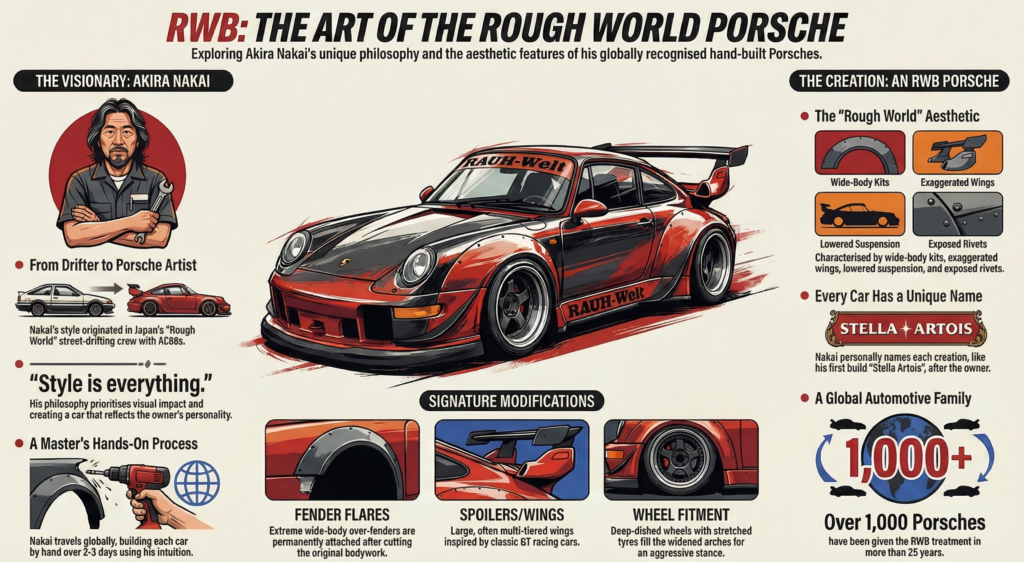
Nakai-san was a pioneer of the oni-kyan or “demon camber” style. In the subterranean world of Japanese drifting, this wasn’t merely a visual affectation; it was a functional necessity. By running extreme negative wheel camber and lowering the chassis until it scraped the asphalt, Nakai was able to maximize the contact patch of his tires during high-speed, high-angle slides. His AE86s were characterized by matte-black finishes, deep-dish wheels, and tires stretched to their absolute limits. This “rough style” was born of a DIY ethos—if it broke, you riveted it; if it didn’t fit, you cut it.
The pivot to Porsche occurred in the late 1990s when a 28-year-old Nakai encountered a damaged 930-generation 911 Turbo while working at a local body shop. He was captivated by the car’s Teutonic foundations and its aesthetic potential, which mirrored the Group 4 and Group 5 race cars he admired. He purchased the project car and spent years refining what would become the first RWB: “Stella Artois.”
Named after his favorite Belgian beer, Stella Artois was a jet-black beast with gold lettering, featuring wide fenders that echoed the Porsche 934 and 935. Nakai even bolted a Stella Artois bottle cap to the rear bumper as a permanent “sticker,” signaling his rejection of high-end, sterile car culture. The name he chose for his shop, Rauh-Welt Begriff, translates to “Rough World Concept.” It was a linguistic bridge, bringing the unrefined energy of Japanese street drifting to the high-precision legacy of German sports cars. This transition was counter-intuitive: he took a vehicle associated with elite prestige and applied a “Rough” philosophy that prioritized narrative and presence over factory-spec perfection.
The Art of the Irreversible Cut
To watch Akira Nakai work is to witness a performative ritual that feels both high-stakes and strangely casual. While contemporary tuning houses rely on CAD software, 3D scanning, and laser-guided precision, Nakai-san relies on his eye, his fingertips, and an air-powered saw.
The centerpiece of any RWB build is the “fender cut.” For many observers, this is a moment of pure anxiety. Nakai-san applies a line of masking tape, traces a curve with a marker, and immediately begins to scream through the original German sheet metal. Once the saw bites, there is no turning back.
“There is an intense feeling during the first fender cut; once the metal is breached, there is no legacy left to preserve, only a future to build.”
This brings us to the “Master vs. Hack” debate that rages in the comments of every Speedhunters feature. Dissenting voices, like those of J.B. McClure and Brent Atwood, are vocal in their criticism. They point to Nakai’s use of hardware store silicone sealant to fill gaps between the body and the fenders, his “eyeballed” wheel alignment, and his use of aluminum tape as evidence of a “hack job.” McClure famously noted that seeing a “master craftsman” seal a sheet metal gap with tape and bathroom-grade silicone was “as hack as it gets.”
However, for the RWB faithful, this lack of high-tech tools is the point. It is an artisanal, human touch in an automated world. Nakai’s ability to achieve a perfect stance by eye—adjusting ride height until the fender sits mere millimeters from the tire—is why he is the “Porsche Charisma Tuner.” He even incorporates linguistic corrections into the brand’s evolution; early cars featured the sticker “Sekund Entwicklung” (Second Development), which was later corrected to “Zweite Entwicklung” to fix a German grammatical error. Whether he is a master or a glorified body-kit installer is a matter of perspective, but his commitment to the “Rough” aesthetic—imperfections and all—is undeniable.
“Style is Everything” – The Philosophy of Individualization
Nakai-san’s design ethic is succinct: “Style is everything.” This philosophy dictates that an RWB Porsche is not a mass-produced product but a three-dimensional automotive canvas designed to stop onlookers “dead in their tracks.”
A central pillar of the RWB brand is the personal connection between the builder and the owner. Nakai does not simply sell a body kit; he builds a car for a specific person. This process begins with an interview intended to “unveil” the owner’s character. Nakai spends time getting to know the recipient during the 2-to-3-day transformation, and only at the end of the build does he assign the car a unique name. These names are never chosen by the owner; they are gifted by Nakai.
These names often carry deep Shinto or personal significance:
- Susanoo: (Indonesia #10) Named after the Shinto god of the sea and storms, reflecting the violent, aggressive beauty of the 993 wide-body kit.
- Miyabi: (Kuala Lumpur #1) Meaning “Elegant” or “Refined,” highlighting the car’s balanced, sophisticated presence.
- Yamato Nadeshiko: Named for the “ideal” Japanese woman/flower, representing a balance of strength and grace.
- Tsubasa: Meaning “Wings,” named for the Indonesian owner’s son, reflecting a wish for him to soar high and protect his family.
This naming ritual transforms the vehicle from a machine into a bespoke piece of art. For many owners, the RWB makeover is a form of rejuvenation. Nakai often claims that many of the 911s he modifies were “tired” projects—cars in less-than-desirable condition that would have been left for scrap or parts if they hadn’t received the RWB treatment.
The Technical Evolution – From Air-Cooled to the 997 and V8 Swaps
While RWB was built on the backs of air-cooled legends like the 930, 964, and 993, the brand has evolved to embrace the water-cooled era. The transition to the 997 platform presented a significant technical hurdle: unlike the single-layer metal of older models, the 997 features a complex dual-layer metal body structure.
During the development of the 997 kit, Nakai utilized a purely analog approach, layering resin and glass fiber directly onto a Carrera 2 to sculpt the prototype. He would run his fingertips over the surfaces to ensure the curves flowed naturally with the factory lines. Technical solutions for the 997 are bespoke; because the wide-body flare covers the factory gas cap, Nakai had to engineer a new hinge system for the cap to function. Furthermore, for the 997 Turbo builds like Tsubasa, Nakai-san utilizes specific “Turbo templates” to manually cut into the wide-body kit, allowing airflow into the factory intakes.
Perhaps the most radical departure from tradition is the Malaysia-based Yamato Nadeshiko. This 993 build features a 7.0L LS7 V8 swap producing over 600hp, paired with an AirREX air suspension system. While purists view an American V8 in a German chassis as sacrilege, within the RWB “Rough World,” it is the ultimate expression of personal freedom. The car also features the “Rotana-style” wing—a massive, aggressive multi-tier spoiler originally designed for Nakai’s personal track car. On Tsubasa, this wing requires a custom cross-bar support system to prevent the fiberglass from flexing under the aerodynamic load at high speeds. These builds prove that RWB is not just about aesthetics; it is about creating an “eye-candy” machine that is a functional, albeit extreme, performance tool.
The RWB Museum and the Global “Family”
RWB is not a traditional shop; it functions more like a decentralized fraternity. This global “family” is maintained through a strict vetting process for authorized partners (such as RWB UK, RWB Thailand, and RWB Indonesia). These partners, vetted by Nakai and his international business developer, Toshi-san, act as gatekeepers.
A unique hospitality requirement defines the experience: whoever commissions a build must host Nakai-san personally. This often involves the owner and the builder sharing meals, drinks (often Jack Daniel’s or Stella Artois), and long nights in the workshop.
The cultural heart of the brand is the RWB Museum in Kuala Lumpur, Malaysia, established by director Christian Coujin. The museum is a “man cave” and sanctuary for the movement. One of its most striking features is a wall decorated with cut fenders from 24 different RWB-converted 911s, each bearing a hand-written message from the owner.
The museum houses artifacts that chronicle Nakai’s journey:
- The Nike AF1s: A well-used pair that looks like they have been through a “war zone,” covered in sealant and dust.
- The Winstons: Packs of the specific brand of cigarettes Nakai smokes during every build break.
- The Flip Phones: His ancient mobile devices and pocket English-Japanese dictionaries, which show his humble efforts to communicate with his global family.
- The Suitcase: One of his well-traveled Rimowa suitcases, used strictly for tools, never for clothes (which he carries in a supermarket bag).
This space solidifies RWB as a legitimate cultural movement rather than a mere tuning trend, blending Japanese craftsmanship with South East Asian enthusiasm and a touch of royal approval—the museum opening was attended by His Highness Tunku Idris of the Johor Royal Family.
The Diecast Legends – Why 1:64 Scale is Big Business
Because Nakai-san only builds 50 to 70 cars a year, and only around 1,000 exist globally, the diecast market has become the primary way for enthusiasts to participate in the RWB dream. This has turned 1:64 scale models into high-value collector assets, fueled by “Hypebeast” culture and extreme scarcity.
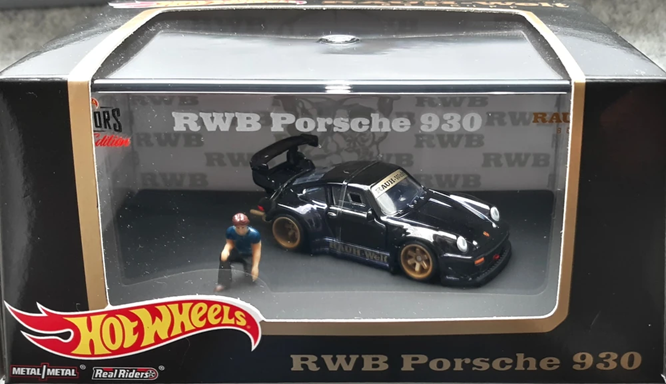
The Hot Wheels Red Line Club (RLC) releases are particularly volatile. The 2020 Spectraflame Black 930, which included a miniature Akira Nakai figure, retailed for $30 but now commands up to $560 on the secondary market. The September 2025 release of the Spectraflame Teal variant, a color that blends metallic gold graphics with high-end paint sold out in just 11 minutes. This market is plagued by “FOMO” and professional scalpers, as orders are often cancelled due to the sheer volume of demand.
RWB Diecast Secondary Market Comparison
| Model Name | Brand / Scale | Retail Price | Secondary Market Value (Approx.) |
| RWB 930 (Spectraflame Black) | Hot Wheels RLC / 1:64 | ~$30.00 | $350 – $560 |
| RWB 930 (Spectraflame Teal) | Hot Wheels RLC / 1:64 | $38.00 | $110 – $130 |
| RWB 993 (Joshua Vides) | Tarmac Works / 1:64 | ~$30.00 | $45 – $65 |
| RWB 930 (Purple/Team Transport) | Hot Wheels / 1:64 | ~$15.00 | $80 – $100 |
| RWB 911 930 (Signed) | Ignition Model / 1:18 | ~$315.00 | $675 |
High-end collaborations, such as the Tarmac Works x Joshua Vides 993, treat the car as an art piece, utilizing Vides’ signature 2D illustrative style. For collectors, these miniatures represent the narrative provenance of the full-sized cars—pieces of the “Rough World” they can actually own.
What the World Needs Now is Rough
As Akira Nakai finished his work at the RWB Museum in Malaysia, he didn’t give a grand speech. Instead, he took a stencil and some white paint to a brick wall. The message he left behind has become the central thesis of the entire brand: “what the world needs now is rough.”
This sentiment summarizes the enduring appeal of RWB. In an era where automotive design is increasingly dictated by wind tunnels and safety sensors, and where cars are becoming sterilized digital platforms, Nakai-san’s hand-built, saw-cut approach offers a visceral connection to the machine. The irreversible cut of the fender is a liberation from the preciousness of the “sacred” 911.
As RWB moves forward into the era of the modern, sensor-heavy 992, the challenge will be reconciling this analog “Rough World” with a digital reality. But as long as there is a man willing to sleep on a workshop floor and a group of owners willing to let him cut into their Porsches, the Rough World will continue to thrive. After all, in a world of perfection, there is something deeply necessary about being a little bit rough.