
Highlights
- This Hot Wheels Mercedes set marks the first appearance of the Mercedes-Benz 300 SLR casting in the Car Culture range.
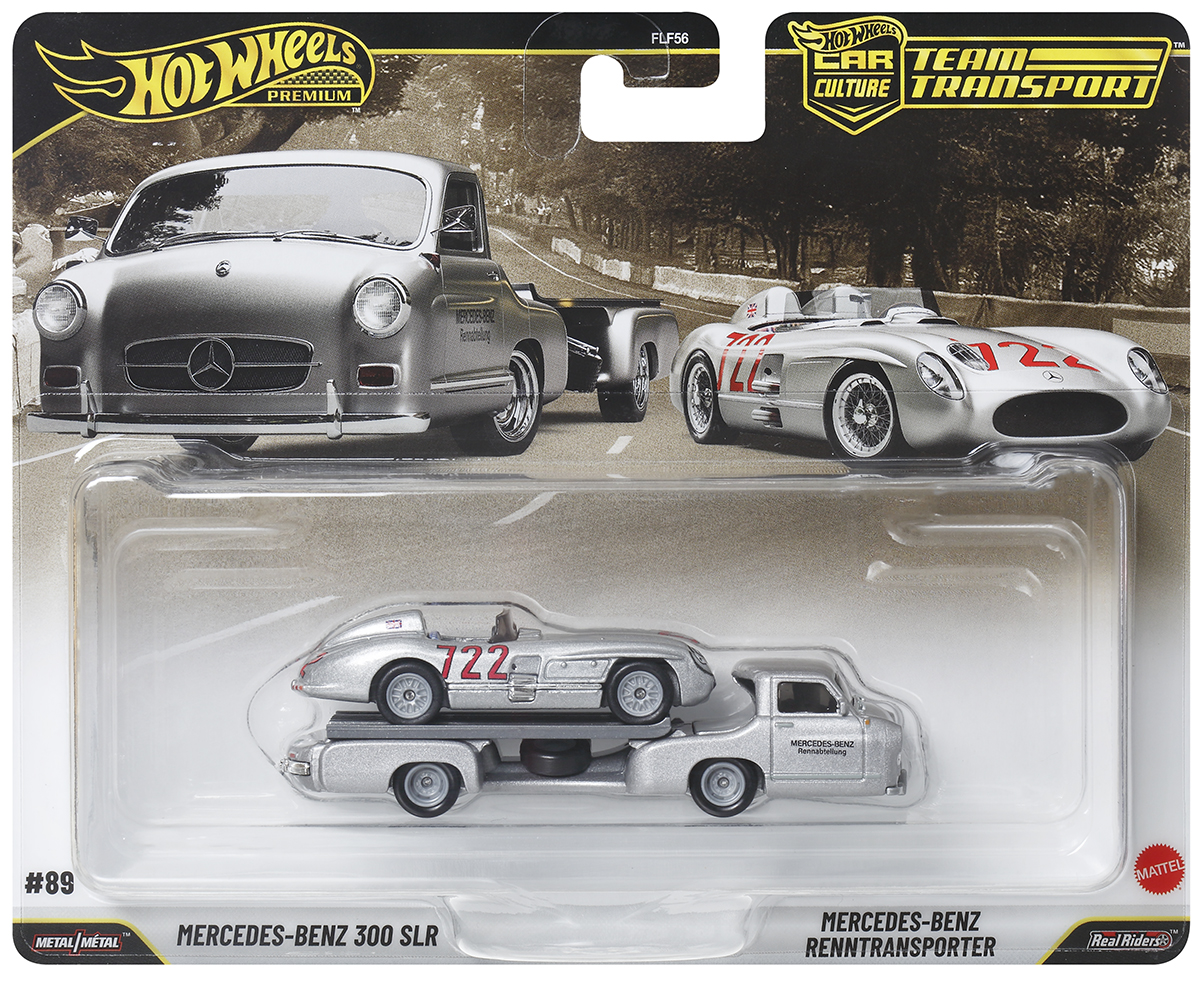
- Finished in authentic silver, the set includes the ‘722’ Moss/Jenkinson Mille Miglia car and the ‘Renntransporter’ support truck. The number ‘722’ denotes their 7:22 AM start time.
TrackDiecast Collect-O-Meter Score: 83 out of 100 → Ultra Collectible ⭐️⭐️⭐️⭐️⭐️- Both vehicles feature metal body construction and Real Riders rubber tires.
- 300 SLR featured a 3 liter straight-eight engine with desmodromic valve control and direct fuel injection. It produced up to 310 PS. Mercedes-Benz engineers based the 300 SLR’s technical design on the W 196 R Formula One champion, ensuring the new sports racer shared the same winning pedigree.
- Driven by Stirling Moss and Denis Jenkinson, this specific car won the 1955 Mille Miglia at a record average speed of 157.65 km/h over 1,600 kilometers.
- Beyond the Mille Miglia, the 300 SLR secured 1–2 finishes at the Eifelrennen and Swedish Grand Prix. Also, a 1–2–3 sweep at the Tourist Trophy, ultimately winning the World Sportscar Championship.
- Built in 1954 to provide fast logistics between the factory and the track. The Renntransporter earned the title of the fastest racing car hauler in the world by reaching a top speed of 105 mph (170 km/h).
- The company scrapped the original one-off vehicle in 1967. Because no original plans existed, Mercedes-Benz painstakingly created an authentic reconstruction over seven years. It is now displayed at the Mercedes-Benz Museum.
Overview
The true ‘Grail’ castings aren’t necessarily the ones with the flashiest paint or the rarest liveries. Instead, the castings that truly resonate, bridge the gap between a 1:64 scale model and a monumental piece of automotive history. For the 2026 Car Culture season, Mattel has handed us exactly that. The Hot Wheels Team Transport set number 89 is more than just a premium two pack. Hot Wheels designers meticulously crafted this set as a museum piece in a blister pack.
This set pairs the legendary Mercedes-Benz 300 SLR. This car dominated the 1955 racing season with almost supernatural efficiency. It was supported by an equally iconic support vehicle, the Mercedes-Benz Renntransporter. For the gearhead, this is a masterclass in mid-century German engineering. For the diecast enthusiast, it marks the debut of a brand new casting. Let’s crack the case and look at why this specific Mercedes-Benz 300 SLR diecast is the definitive expressions of engineering excellence.
Breaking Down Hot Wheels Mercedes Team Transport Set Number 89
In the hierarchy of diecast collecting, the Team Transport series occupies a rarified space. Hot Wheels designers designed it for the collector who values weight, texture and historical narrative. Series position #89 in the 2026 lineup represents a high water mark for the Car Culture range.
- Product Specifications:
- Construction: Full Metal/Metal. Both the 300 SLR and the Renntransporter feature a heavy metal body and a matching metal chassis.
- Wheel Treatment: Real Riders rubber tires, specifically designed to mirror the profile of the 1950s era Continental tires.
- Finish: A cohesive, high-fidelity silver finish that unites the race car and the hauler into a singular visual narrative.
- The Debut: Most importantly, the 300 SLR is a completely new casting for 2026. This isn’t a simple re-tool or a color swap; it is its first appearance in the premium range.
The visual coherence here is stunning. By matching the silver of the Renntransporter to the SLR, Hot Wheels captures the look of the Mercedes-Benz Rennabteilung (Racing Department). This is how it would have appeared at the Nürburgring or the Targa Florio. It isn’t just a pairing of two vehicles; it’s a snapshot of a full ecosystem of racing dominance.
Key Details
Set Details
| Attributes | Details |
| Release Year | 2026 |
| Manufacturer | Mattel |
| Brand | Hot Wheels |
| Segment | Premium |
| Assortment | Car Culture |
| Series | Team Transport |
| Mix Number | 02 |
| Set Number | 01 |
| Series Index | 89 |
| Scale | 1:64 |
| Wheels | Real Riders |
| Body Material | Metal |
| Base Material | Metal |
| Region | International |
| Country of Origin | Thailand |
Car Details
| Attribute | Details |
| Make | Mercedes-Benz |
| Car Casting Name | 300 SLR |
| Casting | New |
| Casting Designer | Ronald Wong |
| Art Director | Steve Vandervate |
| Casting Release Year | 2026 |
| Casting Code | JHX90 |
| Base Codes | U50A, U50N |
| Base Color | Silver |
| Body Color | Metalflake Silver |
| Interior Color | Gray |
| Window Color | Clear |
| Livery / Graphics | Number 722 on Door & Hood |
| Decals / Sponsors | None |
| Wheel Type | RR-D7 Real Riders Davin 7 Spoke |
| Real-world car exists? | Yes |
Transporter Details
| Attribute | Details |
| Make | Mercedes-Benz |
| Transporter Casting Name | Blaus Wunder Renntransporter |
| Casting | Existing |
| Casting Designer | Mark Jones |
| Art Director | Steve Vandervate |
| Casting Release Year | 2023 |
| Casting Code | HKC17 |
| Base Codes | U50A, U50N |
| Base Color | Silver |
| Body Color | Anodized Silver |
| Interior Color | Gray |
| Window Color | Clear |
| Livery / Graphics | None |
| Decals / Sponsors | Mercedes-Benz Rennabtellung |
| Wheel Type | RR-PR10-GY Real Riders Pro Racing 10-Spoke Goodyear |
| Cab Style | Cab Over Engine (COE) |
| Trailer Type | Flatbed |
| Loading Mechanism | Slide-Out Ramp |
| Real-world transporter exists? | Yes |
TrackDiecast Collect-O-Meter Score
| Attribute | Score (1–5) | Reasoning |
| Car / Vehicle | 5 | The Mercedes-Benz 300 SLR is one of the most celebrated racing cars in automotive history. It won major international events, including the 1955 Mille Miglia. It enjoys legendary status among Mercedes-Benz, motorsport and classic car collectors. |
| Transporter / Hauler | 5 | The Mercedes-Benz Renntransporter (“Blue Wonder”) is arguably the most famous racing transporter ever built. It is instantly recognizable and highly desirable among both diecast and automotive historians. Silver Renntransporter in this set is re-paint of original blue Renntransporter (“Blue Wonder”). |
| Motorsport Heritage | 5 | This pairing represents one of the most historically authentic combinations in the Team Transport series. The 300 SLR and Renntransporter were directly associated with Mercedes-Benz’s factory racing program during the 1955 season. |
| Display Appeal | 4 | The matching silver color on 300 SLR & Renntransporter, premium detailing and authentic pairing create an outstanding display piece. It is one of the most visually cohesive Team Transport releases. |
| Collector Demand | 4 | The combination of a legendary race car, an iconic transporter and historical authenticity has made this, one of the most sought-after Team Transport releases. |
| Observed Scarcity | 3 | Collector observations indicate that the set is moderately scarce after its initial retail release. It appears less frequently than average on the secondary market. However, it is still obtainable in secondary market. |
| Secondary Market Price | 3 | Marketplace observations generally show the set selling at a moderately high price over original retail price. While prices are consistent, available evidence does not justify assigning the highest category across all regions. |
| Total | 29 |
Normalized Score: 29/35 * 100 = 83
Rating: Ultra Collectible ⭐️⭐️⭐️⭐️⭐️
Rating Level:
- 90-100: Legendary ⭐️⭐️⭐️⭐️⭐️⭐️
- 80-89: Ultra Collectible ⭐️⭐️⭐️⭐️⭐️
- 70-79: Highly Collectible ⭐️⭐️⭐️⭐️
- 60-69: Collector Worthy ⭐️⭐️⭐️
- 50-59: Casual Collectible ⭐️⭐️
- Below 50: Less Desirable ⭐️
To get more details about how Score & Rating is calculated, check – TrackDiecast Collect-O-Meter Score Calculator.
Diecast Accuracy Analysis: Hot Wheels vs. History
The 300 SLR casting specifically replicates the Moss/Jenkinson Mille Miglia car with incredible precision for 1:64 scale.
300 SLR Model Precision
- The Livery: The ‘722’ race number is perfectly added.
- Exterior Features: The casting includes the streamlined shrouds behind the head restraints. One of the shrouds folds up for the fuel filler on the real car. It also include the side exit exhaust pipes that necessitated the ‘no right door’ design.
- The Air Brake: Mattel correctly included the Le Mans-spec air brake, reflecting the ‘Number 1’ test vehicle that is now part of the Mercedes-Benz Museum collection.
- Authenticity Note: Look closely at the boot lid. You’ll see the ‘D’ (Deutschland i.e. Germany) identifier. On the real racing sports car, the large ‘D’ country identifier functions as a flip-up latch to unlock the hatch. A clever feature that Hot Wheels captured perfectly in its 2026 debut casting.
- Interior: While tiny, you can see the attempt to replicate the blue checkered gabardine fabric seats. In the real car, Mercedes-Benz designers positioned the pedals to the right of the transmission tunnel. This layout required the unusual widening of the driver’s seat toward the front. This is not replicated in 300 SLR in this set.
- Number Plate: Hot Wheels has replicated the exact number plate, ‘W21-6170’.
- Union Jack: Just like the real car, Hot Wheels designers drew The Union Jack correctly on the body behind the driver’s head restraint.
The Renntransporter Critique
The hauler, finished in matching silver for this set captures the avant-garde spirit of Robert Friess KG’s bodywork. The real ‘Blue Wonder’ was blue. Hot Wheels included the original Blue Wonder (Blaues Wunder) in Team Transport set number 70, pairing the transporter with the Mercedes-Benz 300 SL.
- The Lettering: The ‘Mercedes-Benz Rennabteilung’ (Racing Department) text is period correct and sharp.
- Design Scalability: Hot Wheels designers beautifully scaled the Blue Wonder’s avant-garde body, specifically capturing the signature front axle overhang and the flowing, rounded rear end in 1:64 scale.
- The Real Riders: The rubber tires on the transporter feel substantial, echoing the heavy duty service tires that would have carried a 300 SLR across the Swiss Alps.
Collectors would love to have more detailed versions of 300 SLR. Mattel should release a highly detailed 300 SLR in the Red Line Club (RLC), Elite64 or as a Hot Wheels Convention Model, featuring an opening hood that reveals the eight cylinder engine and an opening trunk that showcases the two spare wheels.
Rarity & Availability: A Collector’s Perspective
When you look at a set like this, you are looking at a demographic that includes,
- The Motorsport Heritage Collector: Who is interested in Vintage Motorsport related castings.
- The Silver Arrows Enthusiast: Who focuses on Hot Wheels Mercedes Benz castings.
- The Premium Collector: Who collects premium castings to maintain a complete series run.
This set checks many checkmarks observed by diecast collectors and specifically by the 1:64 scale Hot Wheels Premium collectors. Considering the motorsport history related to this set, this set will always be in demand. As years pass, its price in secondary market will go on increasing.
‘Keep in Blister’ or ‘Free the Piece’?
In the diecast market, First Appearance or First Edition has a special place. Because this 300 SLR is a new casting for 2026, its appreciation trajectory is significantly steeper than a simple re-color of an existing casting.
Why This Set Will Appreciate
- Narrative Value: Team Transport sets always command higher premiums because they offer a ‘complete story’. The pairing of the 300 SLR with its transporter is on of the most historically coherent pairing Mattel has released.
- The ‘Swiss Test Drive’ Factor: In 1956, the editors of Automobil Revue took the 300 SLR prototype on a 3,500 kilometer test drive. They gushed about it being a “being from another world,” as if they were “scientists faced with an alien at Roswell.” That kind of mythical status translates directly into collector demand.
- Scarcity of the SLR Casting: First run premium castings in the Car Culture range are notoriously difficult to find once the next wave hits the shelves.
Whether you choose to ‘free the piece’ to feel the weight of the metal on metal construction or keep it sealed, set #89 is a cornerstone release.
The Real Car: Rudolf Uhlenhaut’s ‘Dazzling Exception’
To truly appreciate what you’re holding in your hand with this Mercedes-Benz 300 SLR diecast, you have to understand the genius of Rudolf Uhlenhaut. As the head of passenger car development and the racing division at Mercedes-Benz, Uhlenhaut didn’t just build cars; he created ‘dazzling exceptions’ to the laws of physics.
The 300 SLR (W 196 S) was essentially a Formula One car in sheep’s clothing. Mercedes-Benz engineers derived the 300 SLR’s technology directly from the W 196 R Grand Prix champion, modifying the design to withstand the brutal environment of endurance sports car racing. Uhlenhaut took the single seater monoposto layout and adapted it for two abreast seating, added headlights and widened the chassis. He created a machine that was equally good at home on the open roads of Italy as it was on the high speed straights of Le Mans.
Technical Deep Dive: The Engineering of the W 196 S
The specs of the 300 SLR read like a science fiction novel from 1955. It was a vehicle that reached the absolute limits of technological possibility for its era.
- The M 196 S Engine: A naturally aspirated 3 litre straight eight (2,982 cc). To achieve a lower center of gravity and a more aerodynamic hood line, the engine was canted to the right at a 53 degree angle. This clever bit of packaging is why the diecast features that distinctive ‘bulge’ on the passenger side of the hood.
- The Desmodromic Revolution: Unlike standard engines that use springs to close the valves, the M 196 S used two spur-gear driven overhead camshafts to positively actuate both the opening and closing of the valves. This eliminated valve float at high RPMs. This allowed the engine to scream up to its 7,400 rpm redline without the risk of mechanical failure.
- Power and Performance: The engine was rated at a continuous 302 PS (222 kW), though it was known to peak at 310 PS. This propelled the 901 kg roadster to reach 300 km/h, a terrifying prospect on 1955 era tires and roads.
- The ‘Elektron’ Body: The car’s skin was crafted from ultra light ‘Elektron’ magnesium alloy. With a relative density of just 1.8, it was the key to the car’s light alloy dominance. This density is less than a quarter of the density of iron.
- The Air Brake: At Le Mans, Alfred Neubauer, the director of motorsports, realized that the massive inboard drum brakes were struggling to decelerate the car from 180 mph. His solution? A 0.7 square meter light alloy ‘wind brake’ that hinged up from the rear deck. This spoiler not only relieved strain on the brakes but dramatically improved cornering stability.
The Uhlenhaut Coupé: The 180 MPH Company Car
Of the nine W 196 S chassis produced, two were built as closed coupés with the iconic gull-wing doors. These are the famous ‘Uhlenhaut Coupés’, effectively road legal racers. When Mercedes-Benz abruptly withdrew from racing at the end of 1955, Rudolf Uhlenhaut took one of these leftover mules and used it as his personal company car.
Rudolf Uhlenhaut famously drove his 220 kilometre commute between Stuttgart and Munich in just about an hour using his 300 SLR company car. In May 2022, an unknown collector purchased the sibling to Uhlenhaut’s personal car at auction for a record €135 million, establishing it as the most expensive car ever sold in human history.
The Real Transporter: The ‘Blue Wonder’
Every legend needs a supporting cast and for the 300 SLR, that was the Mercedes-Benz Renntransporter. Known affectionately as the ‘Blue Wonder’, this vehicle was built in the Mercedes-Benz test workshop in 1954.
The racing department wanted a vehicle that could move cars at high speeds between the Stuttgart plant and European race tracks.
- The Frame: Sourced from the exclusive 300/300 S (W 188) luxury models.
- The Engine: The M 198 straight-six from the 300 SL Gullwing, delivering 192 PS.
- The Body: Components like the doors and windscreen were taken from the Mercedes-Benz 180 Ponton saloon.
The actual construction of the body was handled by Robert Friess KG in Malmsheim, near Stuttgart. The result was a design that looked like it belonged in a Roswell hangar. It abandoned the traditional separation between the cab and the load platform. Instead, the cab was positioned ahead of the front axle, creating an avant-garde silhouette with a massive front overhang.
Performance and Legacy
The Blue Wonder was more than a pretty face. It could hit 170 km/h (105 mph) while carrying a race car. This speed caused a sensation across Europe. Historical photos show the ‘Max. speed 105 m.p.h.’ painted proudly on the rear mudguards. Tragically, the original vehicle was scrapped in 1967. However, realizing it was a ‘work of art’, Mercedes-Benz painstakingly rebuilt it in 2001 using archive documents. They ensured every detail like the blue paint, checkered interior fabric was authentic.
Motorsport Heritage: 1955, The Year of the Stirling Moss 722
Holding the Team Transport set 89 set is like holding a piece of the 1955 Mille Miglia. That race, a 1,000 mile sprint from Brescia to Rome and back, is where the Stirling Moss 722 legend was born.
The Record-Breaking Win
On May 1, 1955, Stirling Moss and his navigator, the fearless motor racing journalist Denis Jenkinson, left the starting ramp at 7:22 AM. This start time gave the car its iconic ‘722’ race number, rendered in large red digits. Jenkinson used a revolutionary 17 foot long paper roll in a metal case to provide pace notes. This allowed Moss to drive at the limit through narrow towns and mountain passes.
The duo averaged a staggering 157.65 km/h (nearly 100 mph) over the entire 1,600 km course. They finished in 10 hours, 7 minutes and 48 seconds. This record still stands today and may never break.
Dominance and the Le Mans Shadow
The 1955 season was one of absolute dominance. The 300 SLR secured 1-2 finishes at the Eifelrennen, the Swedish Grand Prix and the Targa Florio. However, the season was also marked by the horrific disaster at Le Mans. Pierre Levegh’s 300 SLR collided with an Austin-Healey, launching the car into the crowd. The Elektron magnesium body ignited, creating a white hot fire that was impossible to extinguish with water. In fact, water only made the magnesium burn hotter.
83 people lost their lives. While Mercedes-Benz was leading the race at the time, they withdrew out of respect for the victims. By the end of the year, having proven their superiority, the brand withdrew from motorsport entirely to focus on passenger cars.
Technical Specifications Summary
To wrap up, let’s look at the hard data for the real-world machines that inspired this set:
Mercedes-Benz 300 SLR (W 196 S):
- Engine: M 196 S straight-eight, 2,982 cc.
- Power: 302 PS (222 kW) at 7,400 rpm.
- Valve System: Desmodromic (no springs).
- Body: Elektron magnesium alloy.
- Braking: Inboard drum brakes with rear air brake.
- Weight: 901 kg (Roadster).
- Top Speed: ~300 km/h.
Mercedes-Benz Renntransporter (‘Blue Wonder’):
- Engine: M 198 from 300 SL, 2,996 cc.
- Power: 192 PS at 5,500 rpm.
- Top Speed: 170 km/h (105 mph).
- Frame: Sourced from the W 188 (300 S).
- Reconstruction: Original scrapped 1967; Painstakingly rebuilt in 2001.
Conclusion: The Legacy in Your Palm
This set is more than just silver paint and rubber tires. It is a tribute to a ‘zero compromise’ era where engineering was an art and racing was a life and death pursuit. The 300 SLR was the peak of Rudolf Uhlenhaut’s career.
When you hold this set, you are holding the memory of a 7:22 AM start in Brescia. You are holding a reminder of the 135 million euro auction block in Stuttgart. You are looking at a legacy that began with a ‘dazzling exception’ in 1955 and has been preserved for eternity in 1:64 scale.
Will any modern racing program ever match the raw, unbridled excellence of the 1955 Silver Arrows? Until it doesn’t, we have Hot Wheels Mercedes Team Transport set number 89 displaying Mercedes-Benz 300 SLR & Renntransporter. It reminds us of what is possible when engineering has no limits. This isn’t just a diecast set; it is the most wonderful machine ever to grace a collector’s shelf.
FAQs
What is Hot Wheels Team Transport Set #89?
It is Hot Wheels Premium Car Culture Team Transport release pairing a Mercedes-Benz 300 SLR with a Renntransporter also known as ‘Blue Wonder’.
What is the release year of set number 89?
This set was released in 2026. It was a first set of Mix 2.
Is this set rare?
Mattel do not publicly disclose official production quantities but collector chatter and market behavior suggest high demand and limited shelf visibility in most of the locations.
Is it based on real vehicles?
Yes. Both the 300 SLR and Renntransporter are real historical vehicles.
What scale is it?
1:64 scale.
What is the product code?
FLF56 is the assortment code. Casting code for Mercedes-Benz 300 SLR is JHX90 & Casting code for 1955 Mercedes-Benz ‘Blaues Wunder’ is HKC17.
What are the base codes for car & transporter?
Base codes for Mercedes-Benz 300 SLR are U50A, U51A & base codes for Mercedes-Benz Renntransporter are U50A, U51A.
Is this a good display piece?
Yes. The Metalflake Silver 300 SLR and Renntransporter hauler with same color has strong shelf presence and a rich motorsport story.
What is the color of Mercedes-Benz 300 SLR casting?
Base color: Silver
Body Color: Metalflake Silver
Interior Color: Gray
Window Color: Clear
What is the color of Mercedes-Benz Renntransporter casting?
Base color: Silver
Body Color: Anodized Silver
Interior Color: Gray
Window Color: Clear
What Livery/Graphics is used for Mercedes-Benz 300 SLR casting?
Number 722 on Door & Hood signifying the 7:22 AM race start time.
What Livery/Graphics is used for Mercedes-Benz Renntransporter casting?
Mercedes-Benz Rennabtellung. Rennabtellung is a German word which means Racing Department.
Does this set have moving parts?
Yes. Transporter has moving ramp for loading and unloading a vehicle.
What kind of tires are used?
Both car and transporter have rubber tires known as ‘Real Riders’. 300 SLR casting uses RR-D7 Real Riders Davin 7 Spoke tires & Renntransporter casting uses RR-PR10-GY Real Riders Pro Racing 10-Spoke Goodyear tires.
Which loading mechanism is used in transporter?
Loading Mechanism: Slide-Out Ramp
Trailer Type: Flatbed
Cab Style: Cab Over Engine (COE)
What is the material used?
Hot Wheels designers have designed body and base for both car and transporter using metal alloys.
What is the country of origin?
Thailand.
Who is the casting designer for Mercedes-Benz 300 SLR?
Ronald Wong. It was first released in 2026.
Who is the casting designer for Mercedes-Benz Renntransporter?
Mark Jones. It was first released in 2023.
Who is the card art director?
Steve Vandervate.
Resources
Mercedes-Benz 300 SLR (W 196 S), 1955
Wikipedia: Mercedes-Benz 300 SLR
The high-speed racing car transporter for the 1955 season
HAPPY COLLECTING 😊